

How to Photograph and Market an Estate or Probate Listing: The Complete Guide for Vernon and North Okanagan Realtors in 2026
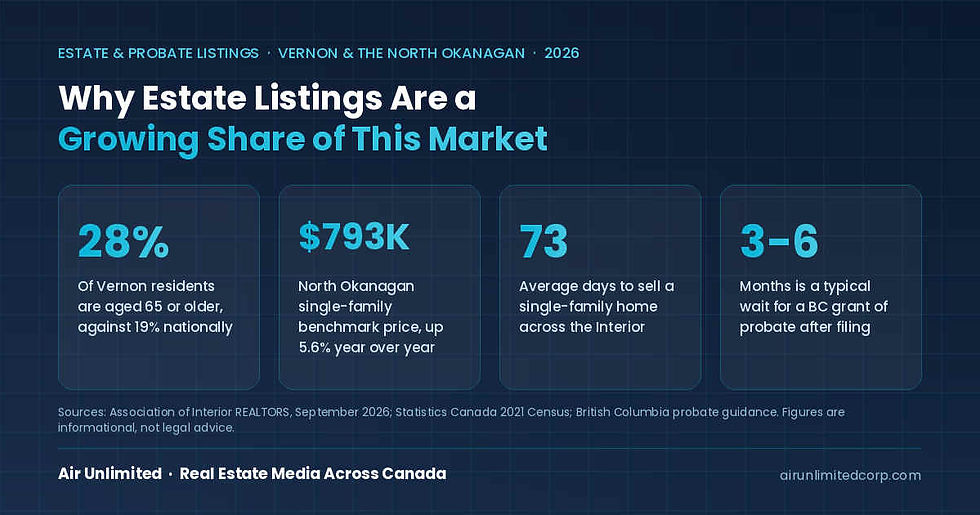
Twenty-eight per cent of Vernon residents are 65 or older — against 19% nationally, according to the 2021 Census. That single number is why a meaningful share of the listings you take across the North Okanagan will arrive through an executor rather than a homeowner, and why those listings behave differently from everything else on your board.
An estate listing is not simply a house with dated carpet. It is a property where the seller has died, the decision-maker is an executor who may live in Calgary or Vancouver, the beneficiaries do not always agree, the probate file sets the closing date, and nobody has a budget for staging. The photographs still have to compete on realtor.ca with a freshly renovated Okanagan Landing rancher that was prepped for three weeks.
This guide covers the practical side of marketing those homes: whether to clear the house before the shoot, how the media schedule fits around a British Columbia probate file, what to photograph and what to leave out, where virtual staging genuinely helps, and how to present dated finishes without either hiding them or writing the home off. It is written for agents working Vernon, Coldstream, Lumby, Armstrong, Enderby, Spallumcheen and the lakeshore between Kalamalka and Swan Lake.
One note before anything else: none of what follows is legal advice. Probate procedure in British Columbia is set by statute and the courts, and the estate's lawyer or notary is the only person who should be confirming dates and conditions.
What You'll Learn in This Guide
Why estate listings are a growing share of the North Okanagan market
What actually makes an estate listing different from a standard one
Whether to clear the home out before the photographer arrives
When an executor should book listing photos relative to the probate file
What to photograph — and what to deliberately keep out of frame
Where virtual staging helps an emptied home and where it backfires
How floor plans, 3D tours and aerials serve out-of-town heirs and buyers
How to present dated finishes honestly without devaluing the home
What the media costs and how estates typically handle payment
Why Are Estate Listings a Growing Share of the North Okanagan Market?
Because the region's population skews older than almost anywhere else in Canada, and the housing stock those residents own is now turning over. Statistics Canada's 2021 Census put Vernon's 65-and-over share at 28%, compared with 19% for Canada and 20% for British Columbia. Only Penticton, at 30%, is older among the major Okanagan centres.
That demographic reality is landing on a market that is otherwise steady. The Association of Interior REALTORS® recorded 129 residential sales in the North Okanagan in September 2026, down from 155 a year earlier, while the single-family benchmark price rose 5.6% year over year to $793,000. Condominiums climbed 4.4% to $324,300. Across the wider Interior, a single-family home took an average of 73 days to sell. Prices are holding; buyers are simply being selective, and selective buyers filter on photographs.
Layer on the intergenerational transfer that financial institutions have been forecasting for years — roughly $1 trillion moving from Canadian boomers to their heirs — and a large portion of it is not cash. It is a three-bedroom house on East Hill with original 1970s cabinetry, a workshop in the carport, and forty years of accumulated life inside it.
What Makes an Estate Listing Different From a Normal Listing?
Four things: the decision-maker is not the occupant, the timeline is set by a court file rather than a moving date, the home is usually full of possessions nobody has sorted, and the people involved are grieving. Each of those changes how you schedule and shoot the property.
The executor is often remote. A daughter in Edmonton or a son in the Lower Mainland is making decisions about a house they can visit twice. Every extra site visit costs them a flight or a nine-hour drive, which is why single-visit media capture matters more here than anywhere else.
The timeline is legal, not personal. A standard seller picks a listing date. An estate works backwards from a Form P1 notice period, a probate application, and a grant that can take months to issue.
The contents are unresolved. Furniture, clothing, tools, paperwork and keepsakes are frequently still in place when you first walk through, sometimes because beneficiaries have not finished dividing them.
Emotion is in the room. You are asking a family to let a stranger photograph their parent's house. Explaining what will and will not appear in the images, before the shoot, removes most of the friction.
The single most useful sentence an agent can say to an executor: "Nothing personal will be identifiable in these photos — no family pictures, no documents, no medications, no mail." It costs nothing and it settles almost every objection to shooting the home.
Should You Clear the Home Out Before the Photo Shoot?
In almost every case, yes — at least partially. A cleared or lightly furnished home photographs dramatically better than a full one, and the clear-out is going to happen regardless. The question is only whether it happens before the camera arrives or after, and doing it after means paying for a second shoot.
The Full Clear-Out: Best Result, Longest Delay
An empty house gives the photographer clean sightlines, full control of light, and rooms that read at their true size. It also lets a buyer picture their own furniture, which is the entire job of a listing photo. The cost is time: a 1,600 square foot Vernon rancher with a full basement and a garage usually takes a crew two to four days plus a dump run, and longer if beneficiaries are selecting items.
The Partial Clear-Out: Most of the Benefit, a Fraction of the Work
If a full clear-out is not realistic, strip the home to what reads as neutral furniture and remove everything that reads as a person. Keep a sofa, a dining set, a bed. Remove family photographs, religious items, medical equipment, mobility aids, medications, mail, financial paperwork, calendars, award certificates and anything with a name on it. That one pass does roughly 80% of the work of a full clear-out and can be done in an afternoon.
Shooting As-Is: Only When the House Is the Product
There is a narrow case for shooting a fully furnished estate home: when it is going to market as a renovation project or a land-value play, and the buyer pool is contractors and investors who are not evaluating décor at all. Even then, the personal items still come out.

When Should an Executor Book Listing Photos?
Book the media once the home is cleared and cleaned — not once probate is granted. Waiting for the grant can idle the property for months while the estate carries taxes, insurance, heat and yard maintenance on an empty house.
In British Columbia, the sequence usually runs roughly like this. Notices to beneficiaries and intestate successors go out, and a waiting period of about 21 days follows before the probate application can be filed. The grant itself commonly takes something in the range of three to six months after filing, and longer if the registry returns the paperwork for correction. A home held in the deceased's sole name generally cannot transfer to a buyer at the Land Title Office until that grant issues.
What that does not mean is that the house cannot be listed. It is common practice in BC to market an estate property and accept an offer before the grant arrives, with completion made conditional on the grant being issued. Your conveyancer or the estate's lawyer will tell you exactly how to word it — but the marketing effect is that the listing is working for those months instead of waiting them out.

One scheduling note specific to the North Okanagan: the shoulder seasons here are generous but short. An October shoot still gets colour on the Kalamalka hillsides; a late-November shoot gets bare deciduous trees and flat grey light. If the clear-out is close to finishing in autumn, finishing it a week early is worth real money.
What Should the Photographer Know Before Arriving?
Tell the photographer three things in advance: that it is an estate property, what has and has not been removed, and who is authorised to be on site. That short briefing prevents the most common estate-shoot failures — a photographer who starts in a room that was supposed to stay closed, or who has to stop halfway through because a beneficiary arrives unannounced.
Access and utilities. Confirm the power is still on. Estate homes are frequently disconnected to save money, and an HDR interior shoot without working lights loses the warm-light layer that makes rooms feel inhabited.
Rooms to skip. If a bedroom is still stacked with boxes awaiting a beneficiary, say so. Skipping it is better than shooting it badly.
What is staying. Appliances, window coverings, a workshop bench or a ride-on mower may or may not be included. Shoot them if they are selling with the house; keep them out of hero frames if they are not.
Sensitive areas. Medical equipment, hospital beds and bathroom aids should be removed before the shoot. If they cannot be moved, that room is photographed from an angle that excludes them.
The yard. Estate properties are often months behind on maintenance. A single afternoon of mowing, edging and clearing leaves changes every exterior and aerial frame.
Should You Photograph Personal Items, Family Photos and Documents?
No. Nothing identifiable belongs in a listing photo on any property, and on an estate listing it is both a privacy matter and a courtesy to a grieving family. Family photographs, correspondence, prescription bottles, bank statements, religious objects, urns, funeral paperwork and anything bearing the deceased's name all come out of frame before the shutter opens.
There is a practical security dimension too. A listing broadcast across realtor.ca and social media tells the world the house is empty. Photographs that show firearms, safes, collections, tools or visible valuables are an invitation. Professional practice is to exclude them from the marketing entirely and describe them in the listing remarks only if they are part of the sale.
Does Virtual Staging Help an Empty Estate Home?
Yes — this is the single highest-value add-on for an estate listing, because estate homes are the ones that end up genuinely empty. The National Association of REALTORS® staging research has found that 83% of buyers' agents said staging made it easier for a buyer to visualise a property as a future home, and an empty 1978 rancher is exactly the case where visualisation fails.
Physical staging rarely makes sense for an estate. It means a monthly rental contract, a damage deposit and a furniture delivery into a house with no one living in it, and the estate is usually trying to minimise carrying costs. Virtual staging delivers the same visualisation benefit at a fraction of the cost, on the same photographs, with no logistics.
Two rules keep it honest. First, every virtually staged image must be labelled as such in the listing — buyers who feel misled at the showing do not write offers. Second, stage furniture, not finishes. Adding a sofa and a rug to an empty living room helps a buyer; silently replacing the kitchen cabinets does not, and crosses into virtual renovation, which is a different product with different disclosure obligations.
How Do Floor Plans, 3D Tours and Drone Help on an Estate Listing?
They do the job that an in-person showing normally does, for the people who cannot attend one. On an estate file, that is usually most of the people involved: heirs scattered across provinces, a buyer relocating to the Okanagan, and an executor who needs the beneficiaries to agree on an offer without flying everyone to Vernon.
Floor Plans Settle Arguments
A measured floor plan gives every beneficiary the same picture of what is being sold and gives buyers the room dimensions and flow that photographs cannot convey. On older North Okanagan homes with additions, enclosed carports and finished basements of uncertain provenance, it also clarifies what is actually finished space.
3D Tours Replace the Flight
A Matterport 3D tour lets an out-of-province heir walk the house at 10pm from their own kitchen, and lets a relocating buyer from the Lower Mainland or Alberta commit to an offer without a scouting trip. It is also a permanent record of the home's condition at the moment it was listed, which is occasionally useful when an estate's beneficiaries later disagree about what was there.
Aerials Sell the Lot
Many estate properties in Coldstream, Lavington, Spallumcheen and the BX carry their value in the land — a half-acre, a shop, an orchard remnant, a view over Kalamalka Lake. Transport Canada certified aerial photography shows lot shape, outbuildings, boundaries and setting in a way no ground-level frame can, and it is often the difference between a buyer seeing a dated house and a buyer seeing a property.

How Do You Photograph Dated Finishes Honestly?
Shoot them accurately, light them well, and let the composition do the arguing. Dated is not the same as bad, and most estate homes in the North Okanagan are structurally sound, well-built houses that simply have not been redecorated since the children left.
Practically, that means a few things on site. Window coverings go fully open so the oak panelling reads warm rather than brown. Fluorescent kitchen tubes get colour-corrected rather than left green. Wide-angle framing stays honest — a 16mm lens flattered into a fisheye makes a galley kitchen look like a hoax by the time the buyer stands in it. And the good bones get their own frames: original hardwood under the carpet, a brick fireplace, a sunroom, a mature garden, a workshop with 220-volt service.
What does not work is pretending. Over-edited images, deleted features and sky replacements on a home that is being sold as-is set up a disappointed showing, and a disappointed showing is worse than a realistic photograph. The same principle applies as on any as-is or fixer-upper listing: accurate images attract the buyer who actually wants the project.
What Does Estate Listing Media Cost, and Who Pays for It?
Expect the same pricing as any other listing of comparable size — an estate property is not a surcharge category. In the Okanagan, a professional photo package for a typical single-family home generally sits in the low-to-mid hundreds, with floor plans, 3D tours, aerials and virtual staging priced as add-ons. Our Okanagan pricing guide breaks down what each component typically costs and what should be included.
The wrinkle on an estate file is who pays. The estate may have limited liquidity until assets are released, which is why many agents carry the marketing cost and recover it at completion, or invoice the estate directly through the lawyer handling the file. Agree on that before the booking rather than after the invoice, and get it in writing with the executor — not with a beneficiary who is not the one authorised to spend estate money.
Whatever the arrangement, the one genuinely expensive outcome is a reshoot. Booking the media before the clear-out is finished, or before the power is reconnected, means paying twice. Every service listed above is captured in a single visit when the house is ready.
What Air Unlimited Covers in the North Okanagan
Air Unlimited serves Vernon, Coldstream, Lumby, Armstrong, Enderby, Spallumcheen and the surrounding North Okanagan, with the full media package captured in one visit:
Professional HDR listing photography that keeps window views and interior detail in the same frame — essential in older homes with small windows
Measured floor plans so heirs and buyers see the same layout and the same room dimensions
Immersive Matterport 3D tours for out-of-province executors, beneficiaries and relocating buyers
Transport Canada certified aerial and drone photography for acreage, outbuildings, lot lines and lake views
Labelled virtual staging to furnish emptied rooms without a rental contract or a delivery truck
Short-form social media reels to put the property in front of local buyers quickly
Frequently Asked Questions
Can you list an estate property in BC before probate is granted?
In practice, yes. It is common to market an estate property and accept an offer before the grant of probate is issued, with the completion date made subject to the grant. The transfer of a home held in the deceased's sole name generally cannot be registered at the Land Title Office until the grant issues. Confirm the exact wording with the estate's lawyer or notary before listing.
Should an estate home be emptied before the photos are taken?
Ideally yes, or at least cleared of all personal items. An emptied or lightly furnished home reads at its true size and lets buyers picture their own belongings. If a full clear-out is not possible before the deadline, removing family photographs, documents, medications and personal effects gets most of the benefit in a single afternoon.
Is virtual staging worth it for an empty estate listing?
Usually, yes. Empty rooms are the hardest for buyers to interpret, and virtual staging furnishes them digitally for a fraction of the cost of a physical staging contract — with no monthly rental and no delivery into a vacant house. Every staged image must be clearly labelled as virtually staged in the listing.
How long does it take to sell a home in the North Okanagan?
Across the Association of Interior REALTORS® region, a single-family home took an average of 73 days to sell in September 2026. The North Okanagan single-family benchmark price that month was $793,000, up 5.6% year over year, while sales volume eased to 129 residential transactions from 155 a year earlier.
Who pays for the listing photography on an estate sale?
It varies. Some agents carry the marketing cost and recover it at completion; in other cases the estate is invoiced directly through the lawyer administering the file. Because estate liquidity is often tight before assets are released, settle the arrangement in writing with the executor before the shoot is booked.
Do you need the executor's permission to photograph the home?
Yes. The executor or administrator is the person with authority to list the property and authorise marketing, not individual beneficiaries. Confirm who holds that authority before scheduling, and let them know in advance that no personal items, documents or family photographs will appear in any image.
Book Your Vernon or North Okanagan Estate Listing Shoot
Air Unlimited provides professional real estate photography, floor plans, Matterport 3D tours, property video, virtual staging and Transport Canada certified aerial drone coverage across Vernon, Coldstream, Lumby, Armstrong, Enderby and the wider Okanagan — backed by 800+ five-star reviews, over 2,000 property shoots completed across Canada, and next-day turnaround on standard photo packages. Every service above is captured in one visit, which matters when the executor is flying in.
Book your North Okanagan shoot today or contact us for a quote on a package built around the property. Call or text 647-905-8001.
Further Reading
Scheduling the shoot: When Should You Book Listing Photos? The Pre-Listing Timeline Guide for Penticton and South Okanagan Realtors in 2026
Okanagan pricing: Real Estate Photography Pricing in Kelowna, BC: What Okanagan Realtors Should Expect to Pay in 2026
Staging choices: Virtual Staging vs. Virtual Renovation: Which Does Your Listing Need?
Remote buyers: How to Market a Listing to Out-of-Town and Relocating Buyers: The Virtual-First Guide
Older housing stock: Real Estate Photography for Bungalows and Single-Storey Homes: The Complete Guide for Chilliwack and Fraser Valley Realtors in 2026
Dark interiors: How to Photograph Homes With Dark Interiors and Small Windows: The Low-Light Listing Guide
Occupied properties: Real Estate Photography for Tenant-Occupied Rental Properties: The Complete Guide for Kamloops and BC Realtors in 2026


Comments