

Virtual Renovation: How Halifax Realtors Show Buyers a Home's Full Potential Digitally in 2026
Listings that show buyers a home's renovated potential sell up to 73% faster and earn as much as 90% more clicks than photos alone. In Halifax, where active listings are up 17.7% year over year and buyers finally have room to be choosy, that gap decides which homes get showings and which ones sit. Yet many of HRM's best-located properties still go to market showing only original 1970s kitchens, dated bathrooms, and worn floors — leaving buyers to do the imagining themselves.
Virtual renovation fixes that. It uses professional photo editing to show a home's full potential digitally: a dated Fairview bungalow kitchen reimagined with new cabinetry and counters, a tired Dartmouth bathroom refreshed, scuffed hardwood in a South End century home refinished, and 1980s finishes brought into 2026 — all before a single contractor is called. Where virtual staging fills empty rooms with furniture, virtual renovation reworks the permanent finishes buyers assume they are stuck with.
This guide breaks down exactly how Halifax realtors use virtual renovation in 2026: what it is, the data behind it, why it matters in HRM's current market, which properties benefit most, what can and cannot be changed, how to stay honest and compliant with Nova Scotia advertising rules, and how it works alongside photography, staging, floor plans, and 3D tours.
What You'll Learn in This Guide
What virtual renovation is and how it differs from virtual staging
The measurable impact of showing potential on clicks, days on market, and price
Why virtual renovation matters in Halifax's 2026 buyer-friendly market
Which HRM properties and neighbourhoods benefit most
What can realistically be changed in a virtual renovation — and what can't
How to use it ethically and stay compliant with Nova Scotia advertising rules
How it fits with photography, staging, floor plans, and 3D tours
What it costs and the ROI on a typical Halifax listing
Frequently asked questions from Halifax realtors
What Is Virtual Renovation and How Is It Different From Virtual Staging?
Virtual renovation is professional photo editing that digitally updates a home's permanent finishes — cabinetry, countertops, flooring, paint, tile, backsplashes, and lighting — to show buyers what a space could look like after an update. It answers the question every dated listing raises: what would this home look like if it were renovated? Rather than hoping buyers can picture it (most cannot), you show them.
The distinction from virtual staging is important, and the two are often confused. Virtual staging adds furniture, rugs, art, and decor to empty rooms so buyers can judge scale and picture living there. Virtual renovation changes the room itself — the surfaces that would cost a buyer real money to replace. Many Halifax listings benefit from both, but for HRM's large stock of original-condition homes, virtual renovation is usually the bigger unlock, because it reframes a property's biggest perceived weakness as its clearest opportunity.
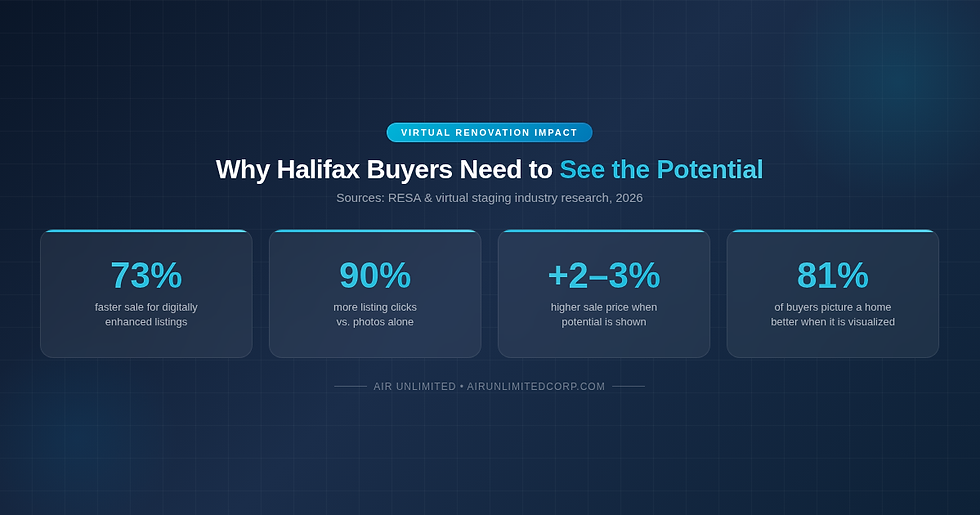
The performance numbers behind digitally enhanced listings are strong. Industry research links visually enhanced listings to sales up to 73% faster and as much as 90% more clicks compared with standard photos, and homes that help buyers visualize potential tend to sell for roughly 2–3% more. On a Halifax home near the HRM benchmark price, that is well over $10,000 of potential upside from an editing service that costs a small fraction of a real renovation.
Roughly 81% of buyers say that being able to visualize a property helps them see it as their own home — the single reason virtual renovation moves listings that photos alone cannot.
Why Does Virtual Renovation Matter So Much in Halifax's 2026 Market?
Virtual renovation matters more in Halifax right now because inventory has climbed, buyers have regained leverage, and much of HRM's housing stock is older than the marketing around it suggests. Halifax-area active listings rose 17.7% year over year to roughly 1,821 units this spring while sales slipped about 6% — pushing months of inventory to 2.4, up from 1.9 a year earlier and well above the historically tight 1.5 seen in 2023.

Pricing power has softened alongside it. The Nova Scotia sale-to-list ratio eased to 97.2% in June 2026 from 98.5% a year earlier, and the sale-to-original-list ratio dropped to 95.3% from 97.0% — a clear sign sellers are conceding more than they were. Meanwhile the HRM composite benchmark price sits near $572,700 with average sale prices just above $600,000. In a market like this, a listing that looks like work gets skipped, not negotiated.
Halifax also has unusually characterful and unusually old housing. Century homes in the South End, Hydrostone rowhouses in the North End, wartime bungalows in Fairview and Spryfield, and 1960s–70s splits across Clayton Park, Dartmouth, and Cole Harbour are full of appeal but frequently carry original kitchens and baths. Buyers walking into one of those homes at today's prices are doing fast, pessimistic renovation math in their heads — and Atlantic Canada's contractor rates and older-home surprises such as stone foundations, knob-and-tube wiring, and fans venting into attics make that math scarier than it needs to be. Virtual renovation replaces the anxiety with a picture.

Which Halifax Properties Benefit Most From Virtual Renovation?
Every dated listing benefits, but the return is largest where the gap between how a home looks today and how buyers wish it looked is widest. As a rule of thumb: the more a property's price is driven by location rather than condition, the more virtual renovation earns its keep.
Century and heritage homes in the South End, Hydrostone, and downtown Dartmouth, where charm is obvious but kitchens and baths are original
Post-war bungalows and splits in Fairview, Spryfield, Clayton Park, Cole Harbour, and Sackville with dated finishes but sound structure
Estate and probate sales where the seller cannot or will not renovate before listing
Investment and multi-unit properties near Dalhousie and Saint Mary's, where investors need to see the after-renovation rent story
Waterfront and view properties on the Eastern Shore, St. Margarets Bay, and the Northwest Arm, where the setting outclasses the interior
Condos in Bedford, Larry Uteck, and on the peninsula competing directly against newer buildings with modern finishes
Rural and semi-rural HRM listings in Tantallon, Hammonds Plains, and Musquodoboit where buyers are already stretching on commute
What Can Actually Be Changed in a Virtual Renovation?
Virtual renovation changes surfaces and fixtures, not structure. Anything that would be swapped in a cosmetic-to-mid-level renovation can generally be shown digitally, and it should always be based on a change that is realistically achievable in that space.
Kitchen cabinetry refaced or replaced, plus new counters, backsplash, sink, and hardware
Bathroom vanities, tile, tub-to-shower conversions, and updated fixtures
Flooring — refinishing hardwood, replacing carpet or dated laminate, new tile
Wall and trim paint, removal of wallpaper and popcorn ceilings
Lighting fixtures, pot lights, and updated switch plates
Exterior refreshes such as paint, siding colour, front door, walkway, and landscaping
Decluttering and removing dated built-ins that visually shrink a room
What virtual renovation should not do is move walls, invent windows, erase a neighbouring building, hide a structural defect, or show a layout that cannot exist. Those edits cross from illustrating potential into misrepresenting the property — and they backfire the moment a buyer walks through the door.
How Do Halifax Realtors Use Virtual Renovation Ethically and Stay Compliant?
Disclosure is the whole answer. Digitally renovated images must be clearly and prominently labelled as virtually renovated in the listing, and best practice is to include the unedited photo of each space alongside it so buyers can compare before and after in the same gallery. Nova Scotia Real Estate Commission advertising rules and the Real Estate Trading Act require that advertising not be false, misleading, or deceptive, and an undisclosed digital renovation is exactly that.
Label every edited image with a clear watermark or caption such as “virtually renovated”
Include the original unedited photo of each renovated space in the same listing gallery
Note the enhancement in the listing remarks so nothing depends on a buyer reading a caption
Keep renovations realistic and physically achievable in the actual space
Never use virtual editing to conceal damage, water staining, mould, or structural issues
Confirm your brokerage's own advertising policy before publishing to MLS
Done this way, virtual renovation is not a trick — it is a visualization tool, the same way a builder's rendering is. Buyers consistently respond well to it because it saves them from guessing, and agents who disclose properly report more informed showings and fewer wasted ones.

How Does Virtual Renovation Fit With Photography, Staging, and 3D Tours?
Virtual renovation is produced from your listing photos, so it belongs inside a full media package rather than as a standalone add-on. The sequence is straightforward: shoot the home properly first, then enhance selectively.
Start with professional HDR photography — clean, well-lit source images are what make convincing digital renovations possible
Add virtual staging for empty rooms, and virtual renovation for occupied or dated ones
Include a Matterport 3D tour so buyers can verify the home's real condition and layout for themselves
Attach an accurate floor plan so buyers can plan the renovation they just saw illustrated
Use drone aerials to show lot size, harbour or ocean views, and neighbourhood context
Cut the best transformations into social media reels — before-and-after clips are among the highest-engagement real estate content on Instagram and TikTok
The 3D tour pairing deserves special mention. A Matterport scan is the honest counterweight to a virtual renovation: buyers see the potential in the stills and the reality in the walkthrough. That combination builds trust and filters out buyers who were never going to take on the work, so the showings you do get are far more serious.
What Does Virtual Renovation Cost and What Is the ROI in Halifax?
Virtual renovation is priced per image and sits among the most affordable items in a listing media budget — typically a small fraction of what a physical renovation of the same room would cost. A real Halifax kitchen renovation runs well into five figures; a digital one that shows the same result to every buyer scrolling the listing costs a rounding error by comparison.
The math works out quickly. On a home near the HRM benchmark of roughly $572,700, a 2% improvement in sale price is over $11,000. Even setting price aside, cutting weeks off days on market saves real money in mortgage interest, taxes, heat, and insurance — carrying costs that add up fast through an Atlantic winter. When virtual renovation is bundled into a full photography and media package, the incremental cost per listing is minimal and the marketing lift is immediate.
There is a listing-presentation benefit too. Walking into a seller appointment with a before-and-after of their own dated kitchen is one of the most persuasive things a Halifax agent can do — it demonstrates a marketing plan instead of describing one.
Frequently Asked Questions About Virtual Renovation in Halifax
What is the difference between virtual renovation and virtual staging?
Virtual staging adds furniture and decor to empty rooms so buyers can picture living there and judge scale. Virtual renovation changes a room's permanent finishes — cabinetry, counters, flooring, tile, and paint — to show what the space could look like after an update. Many Halifax listings, especially older homes in the South End, Dartmouth, and Fairview, benefit from using both together.
Is virtual renovation legal and MLS-compliant in Nova Scotia?
Yes, provided it is clearly disclosed. Nova Scotia Real Estate Commission advertising rules require that listing advertising not be false, misleading, or deceptive, so every digitally renovated image should be labelled as virtually renovated and paired with the unedited original in the same gallery. Always confirm your brokerage's advertising policy before publishing.
How much does virtual renovation cost in Halifax?
Virtual renovation is priced per image and is one of the least expensive items in a listing media package — dramatically cheaper than the physical renovation it illustrates, which in HRM routinely runs into the tens of thousands of dollars for a kitchen. Because it is tied to faster sales and a measurable price lift, most sellers recoup it many times over. Book a shoot for a current quote based on your property and the number of rooms.
Does virtual renovation actually help homes sell faster?
Yes. Industry research links visually enhanced listings to sales as much as 73% faster and up to 90% more listing clicks, and about 81% of buyers say visualization helps them see a property as their own. With Halifax inventory up 17.7% year over year, showing potential up front is one of the most reliable ways to keep a dated listing from being scrolled past.
Can I get virtual renovation and photos in the same shoot?
Yes. Virtual renovation is produced from your professional listing photos, so it is best ordered alongside your photography, drone, floor plan, and 3D tour. Everything is captured in a single visit to the property and the enhanced images are delivered with the rest of your media, usually with next-day turnaround.
Book Halifax's Real Estate Media Team and Sell Faster
In a market with more inventory and more patient buyers, showing a home's potential is one of the simplest ways to make a dated Halifax listing stand out. Whether you are listing a South End century home, a Dartmouth bungalow, a Bedford condo, or an Eastern Shore waterfront property, Air Unlimited delivers virtual staging and renovation, HDR photography, Matterport 3D tours, floor plans, property video, and drone aerials with Transport Canada-certified pilots, next-day delivery, over 2,000 property shoots completed across Canada, and more than 800 five-star reviews.
Book your Halifax shoot today or contact us for a custom quote. Call or text 647-905-8001.
Further Reading
Compare markets: Virtual Renovation: How Victoria Realtors Show Buyers a Home's Full Potential Digitally in 2026
Hire local: How to Choose a Real Estate Photographer in Halifax, Nova Scotia
Budget for it: Real Estate Photography Pricing in Halifax: What Nova Scotia Realtors Should Expect to Pay in 2026
Add video: Why Every Halifax Listing Needs a Video Walkthrough in 2026
Plan the reno: Why Accurate Floor Plans Close Deals Faster: The Complete Guide for Halifax Realtors in 2026


Comments