

Real Estate Photography for Homes With Shops, Oversized Garages and RV Parking: The Complete Guide for Grande Prairie and Peace Country Realtors in 2026
A heated 40-by-60 shop is often the single most valuable structure on a Peace Country property — and it is routinely photographed last, in the dark, with the overhead door closed. In a Grande Prairie market where the average MLS listing sells for $389,727 and 313 new listings hit the board in a single 28-day stretch, that one habit quietly costs sellers their best buyers.
Shop buyers are the most specific buyers in Alberta real estate. They are not scrolling for a backsplash. They want the door height, the condition of the concrete, what the sub-panel is rated at, and whether a fifth-wheel can swing off the approach without three-point-turning across the lawn. If your gallery does not answer those questions, they either phone you for the answers or they scroll to the listing that already did.
This guide is written for agents listing in Grande Prairie, Clairmont, Sexsmith, Beaverlodge, Wembley, Hythe, Bezanson and the wider County of Grande Prairie in 2026. It covers who is actually buying these properties, which shots belong in every shop gallery, how to handle RV pads and approaches, why an aerial frame is non-negotiable on an acreage, and what a media package for a property like this should cost.
What You Will Learn in This Guide
Why shops, oversized garages and RV parking drive value in the Peace Country market
Who buys these properties and the exact questions they scan photos for
How to light and frame a shop interior so it does not read as a dark cave
The eight shop and outbuilding photos every listing should include
How to shoot RV pads, approaches and turning room so buyers can judge access
Why aerial coverage matters on acreages — and how to shoot in a Peace Country winter
Which media add-ons earn their keep, and what the package should cost in 2026
Why Do Shops and Oversized Garages Move Listings in the Peace Country?
Because in this region a shop is infrastructure, not a bonus. Grande Prairie sits at the centre of an economy built on oil and gas services, forestry and agriculture, and a very large share of local buyers need somewhere heated to keep a service truck, a welder, a skid steer, a sled deck or a fifth-wheel through a seven-month winter. A property with a proper shop is not competing with the house next door — it is competing with the far smaller pool of other properties that also have one.
The 2026 market makes presentation matter more, not less. Grande Prairie MLS data puts the average sale price at roughly $389,727 with a median around $417,000 — the gap reflects how wide the local mix is, from in-town Mission Heights bungalows to quarter-section acreages off Highway 43. With 313 new listings arriving in a recent 28-day window and price growth forecast in the modest 2 to 4 percent range, buyers have real choice. Choice means the shortlist is decided in the gallery.

A buyer who needs a heated shop will forgive a dated kitchen. They will not forgive six blurry photos that leave them guessing whether their truck fits through the door.
Who Actually Buys a Home With a Shop in Grande Prairie?
Four buyer types dominate, and each one scans the gallery for something different. Knowing which of them your listing is aimed at changes the shot list before the photographer arrives.
The owner-operator — a hotshot driver, welder, mechanic or oilfield service contractor who needs secure, heated space for equipment and a place to work in January. They look for door dimensions, power, heat and floor condition, in that order.
The RV and toy family — quads, sleds, a boat, a fifth-wheel or a holiday trailer. They want to see the pad, the gate width, the approach off the road and how much turning room actually exists.
The acreage buyer — someone moving out of town to Bezanson, Clairmont or the County for space. They want to understand the whole parcel: where the house sits relative to the shop, the shelterbelt, the dugout and the road.
The home-based business owner — a small operator running from the property. They care about separate access, whether the shop is visible from the road, and whether the site reads as professional in photos.
How Do You Photograph a Shop Interior Without It Looking Like a Cave?
Open the overhead door and expose for the interior, not the doorway. The single most common mistake in shop photography is shooting from just inside a closed door with the shop lights on and the camera metering for the brightest thing in frame. The result is a black box with a glowing rectangle in the middle. A bracketed HDR sequence, blended so the interior, the open door and the yard beyond all hold detail, is the difference between a photo that sells the space and one that hides it.
Shoot from the back corner, not the doorway
Standing in the doorway compresses the room and puts the most interesting part of the building behind the camera. Backing into the far corner and shooting toward the open door does three things at once: it shows the true depth of the bay, it gives the eye a bright anchor point, and it lets the viewer read the width of the span in a single frame.
Give the ceiling its own frame
Clear height decides whether a hoist, a lift or a stacked storage system can ever go in, and buyers cannot infer it from a floor-level wide. One deliberate upward-angled frame showing the trusses, the lighting and any mezzanine answers a question that would otherwise become a phone call.
Treat the floor as a feature
Sweep it, dry it and light it evenly. Concrete condition, a floor drain and a working sump are genuine selling points in a region where vehicles come in wet and salted all winter. A cracked, oil-stained floor photographed in patchy light reads as neglect even when the slab is sound.

Which Eight Shop Photos Should Every Listing Include?
A shop buyer arrives with eight questions and answers them in the order the gallery lets them. Cover all eight and the property stops competing on price alone. The list below is what our photographers shoot on every Peace Country property with an outbuilding, regardless of package.
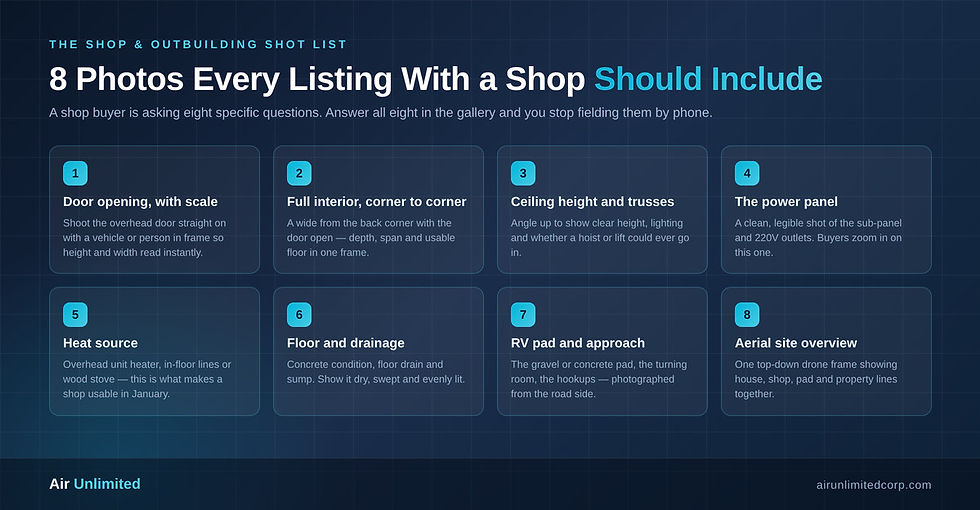
Two of those eight are worth calling out because agents skip them most often. The power panel photo feels unglamorous and is one of the most zoomed-in images in the entire gallery. And a shot of the overhead door with a truck or a person beside it for scale communicates dimensions far faster than a line in the remarks ever will.
How Do You Photograph RV Parking, Pads and Approaches?
Photograph the approach from the road, not from the house. RV buyers are judging one thing: can the unit get in, get turned around and get parked without damaging anything. That is a question about geometry, and geometry only reads when the camera is positioned where the driver would be.
Shoot the approach from the road looking in, so gate width, ditch crossing and turning room are all visible in one frame
Include the pad surface in a frame of its own — gravel, packed clay and concrete are very different propositions in a Peace Country spring
Photograph any hookups clearly: 30 or 50 amp service, water, and sewer or dump access
If the property has a dedicated RV door or a drive-through bay, show it open, from outside and inside
Shoot with the pad empty if possible — a parked unit hides exactly the dimensions the buyer is trying to measure
Why Does Every Acreage With Outbuildings Need an Aerial Photo?
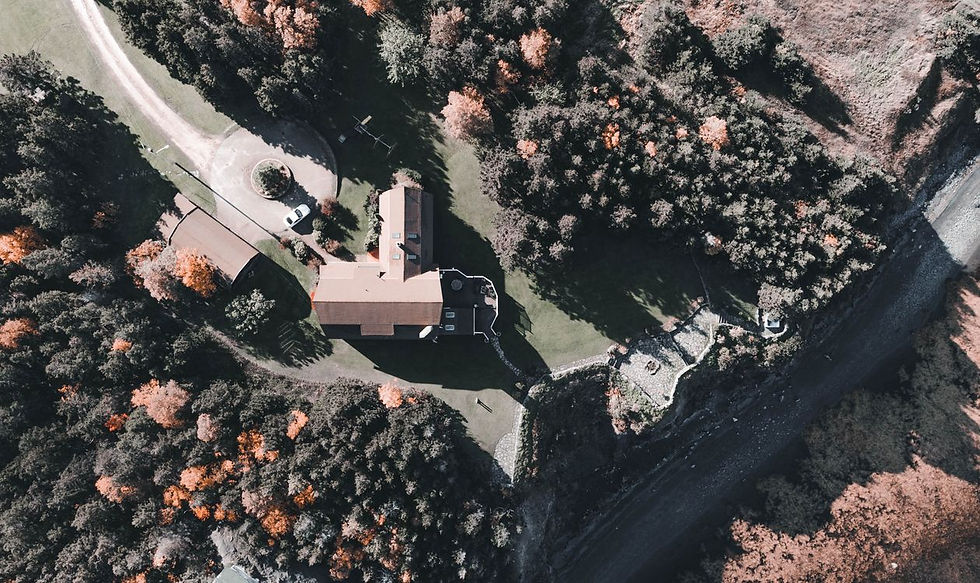
Because ground-level photos cannot show relationships, and on an acreage the relationships are the value. One top-down or high-oblique aerial frame answers where the shop sits relative to the house, how the driveway approaches from the range road, where the shelterbelt and dugout are, and roughly how much of the parcel is cleared. Buyers looking at a quarter section outside Sexsmith or a five-acre parcel near Clairmont are buying the layout as much as the buildings.
Aerial coverage also does quiet work on trust. A property that is photographed only in tight frames invites the suspicion that something is being cropped out — a neighbouring yard, a pipeline right-of-way, a road that runs closer than the listing implies. Showing the whole site removes that doubt before a showing is booked. All Air Unlimited aerial and drone work is flown by Transport Canada certified pilots operating under current Canadian drone regulations.
How Do You Shoot a Shop Property in a Peace Country Winter?
Book earlier in the day and plan around roughly seven hours of usable daylight in December. Grande Prairie sits far enough north that a late-afternoon booking in midwinter means shooting exteriors in blue light and shop interiors with no daylight coming through the door at all. Between November and April, a mid-morning slot is worth more to the finished gallery than any amount of editing.
Have the approach, the pad and the shop apron cleared and bladed before the photographer arrives — snow ridges hide the surface buyers are trying to assess
Move equipment and vehicles off the pad, then move them back after; an empty pad reads as bigger and cleaner
Turn on every light in the shop and the yard, including the dusk-to-dawn, and leave the overhead door open for the wide frames
Expect frost on the inside of shop windows and plan a heat cycle before the shoot rather than fixing it in post
Consider booking summer aerials in advance if you list annually — a green-yard aerial in a January gallery is a legitimate, disclosed way to show the parcel
Should a Shop Get Its Own Floor Plan and 3D Tour?
Yes, whenever the shop is a meaningful part of the price. A shop floor plan with real measured dimensions settles the door-width and bay-length questions in one glance, and a 3D walkthrough lets a buyer in Fort St. John or Edmonton judge the space without a four-hour drive. On properties where the outbuildings represent a large share of the value, this is the media that converts out-of-town interest into showings.
Measured floor plans for both the house and the shop, so bay dimensions and door openings are documented rather than estimated
A Matterport 3D tour that includes the shop interior — invaluable for out-of-region and relocation buyers
Bracketed HDR photography so the open overhead door, the interior and the yard beyond all hold detail in the same frame
Cinematic property video that walks the yard from the road, through the shop and into the house
Vertical social media reels — shop reveals perform unusually well with local trade and RV audiences
Full real estate videography when the property is large enough that stills alone cannot carry the walkthrough
What Should a Shop-Property Media Package Cost in Grande Prairie in 2026?
Expect a full package on an acreage with outbuildings to sit meaningfully above a standard in-town listing package, because there is genuinely more to shoot. A typical Peace Country shop property involves the house, one or more outbuildings, the pad and approach, aerial coverage and often a second floor plan. That is closer to two shoots than one.
The honest way to think about the spend is proportional. If the shop is carrying $80,000 to $150,000 of the asking price, budgeting the same media investment you would give a plain three-bedroom in Kensington is underspending on the part of the property that differentiates it. Air Unlimited has completed more than 2,000 property shoots across Canada and holds over 800 five-star reviews, and the packages that consistently perform on shop properties are the ones that treat the outbuildings as a second subject rather than an afterthought.
Frequently Asked Questions
How many photos should a Grande Prairie listing with a shop include?
Plan on the standard 25 to 35 frames for the house plus 8 to 12 dedicated to the shop, pad and site. A property where the outbuildings carry real value needs its own mini-gallery, not two leftover frames at the end of the set.
Do I need a drone permit to photograph an acreage near Grande Prairie?
The pilot does. Commercial drone operation in Canada requires a Transport Canada certificate and a registered aircraft, and airspace near Grande Prairie Airport carries additional requirements. Hiring a certified operator keeps the liability and the paperwork off the listing agent entirely.
Should the shop be empty for photos?
Mostly, yes. A swept, largely cleared shop lets buyers see the true dimensions and the floor condition. Leaving one vehicle in frame is useful for scale, but a shop packed wall to wall reads as smaller than it is and hides the surfaces buyers want to inspect.
Is it worth photographing an unheated garage or a pole shed?
Yes, and it is worth being honest about what it is. A cold storage shed still has real value to an RV or equipment buyer. Photographing it clearly and describing it accurately attracts the right buyer and avoids the showing that ends in disappointment.
How far in advance should I book a winter shoot in the Peace Country?
Give yourself a week where possible, and hold a mid-morning slot. Between November and April the usable-light window is short and weather can move a booking, so building in a backup day is the difference between shooting in good conditions and settling for whatever the calendar allows.
Ready to Photograph Your Peace Country Listing Properly?
Air Unlimited photographs homes, acreages and shop properties across Alberta with Transport Canada certified drone pilots, bracketed HDR interiors, measured floor plans and full 3D tours. More than 2,000 property shoots completed and over 800 five-star reviews. Book your shoot today or get in touch to build a package around the outbuildings that make your listing worth more than the one next door.
Further Reading
Rural and equestrian coverage: Real Estate Photography for Equestrian and Hobby Farm Properties
Aerial strategy for large parcels: How Aerial Drone Photography Helps Sell Acreage and Farm Properties in Saskatoon
Alberta property types: Real Estate Photography for Homes With Secondary Suites and In-Law Suites in Red Deer
The rules behind the aerials: Transport Canada Drone Rules for Real Estate Photography in 2026
Shooting through the seasons: Seasonal Real Estate Photography Tips for Edmonton Realtors


Comments